
An excerpt from Paul Tenorio's "The Messi Effect"
A deeply reported account of how MLS may have missed the window to fully capitalize on the presence of the greatest player of all-time
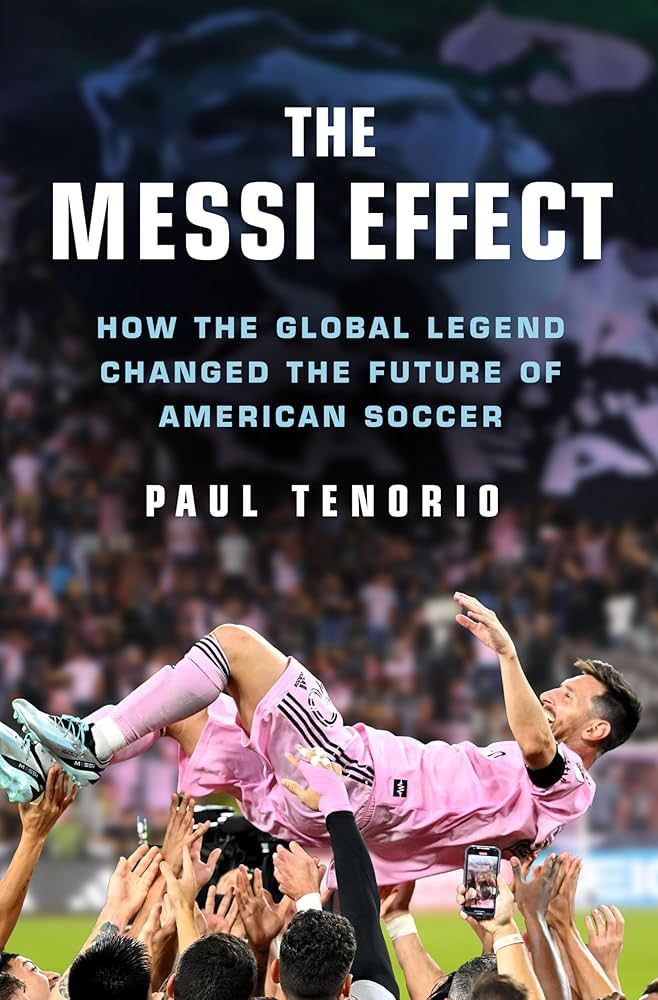
The following is an excerpt from Chapter 19, A Race to Reinvent MLS, from The Messi Effect: How the Global Legend Changed the Future of American Soccer by Paul Tenorio. Courtesy of St. Martin’s Press. The book is available for purchase on June 2.
Twelve days after Lionel Messi made a beeline for the home locker room following Inter Miami’s stunning elimination in the MLS Cup playoffs, Jorge Mas and other MLS owners on the sporting and competition committee sat around a conference table in the Great Room at the W Hotel in West Hollywood, California.
They were joined by MLS commissioner Don Garber, a handful of MLS executives, and Apple TV’s Eddy Cue.
At stake was the future of the league.
The spike in interest Messi delivered to MLS emphasized the league’s strengths: Its ability to draw crowds and leverage commercial partnerships. MLS set an attendance record in 2024, drawing more than eleven million fans for the first time. The league claimed that its total attendance ranked third in the world behind the Premier League and Bundesliga, but the figure obviously was goosed by the fact that MLS had nine to eleven more teams than those leagues and, therefore, many more games.
Off Messi’s back, MLS set new highs on social media, in merchandise retail sales, and in league and club sponsorship sales. Its social presence grew at a higher rate than any other major men’s North American sports league on TikTok, Instagram, and YouTube. That was led by Inter Miami, of course, which was the most followed North American sports team on TikTok with 9.4 million followers and third-most on Instagram with 17.2 million followers. Messi’s Inter Miami jersey continued to rank first in Adidas’s player jersey sales across all sports.
Those numbers were great. None of them helped solve the bigger problems MLS faced.
The league still lacked national appeal. People still weren’t tuning into games on Apple TV in higher numbers, which limited that all-important media revenue. MLS had to find a way to attract more fans.
There were two fundamental issues facing the league: closing the gap in on- field quality between it and other top global leagues, and shrinking the perception gap that existed between what MLS was and what many American sports fans thought it was. MLS was still considered a low- level or minor league. Its stubborn insistence on forced competitive balance enabled a bland product lacking the jeopardy that drove storylines and interest in most other leagues.
MLS had to find a way to evolve—and to change minds.
The question at the committee meeting at the W Hotel was whether the league could alter its path in time to utilize the 2026 World Cup, or if it was too late.
The fact that it felt like a race to the World Cup was itself a failure.
The league’s slow-burn build and training-wheels salary cap strategy might have supported the business and kept it stable through those volatile early years, but survival was no longer the goal. Something more drastic was necessary if MLS was going to break out with broader appeal. MLS had done well to prepare for the end of its previous media deal in 2022. It aligned local, national, and international media agreements to expire at the same time. MLS went to the market with 100 percent of its inventory, looking for a novel type of partnership. The deal with Apple TV had not delivered the kind of interest and windfall that was promised, but whether it succeeded or failed, MLS did the work to land a strong partner and take a big swing.
A similar level of planning clearly had not taken place about how to evolve the sporting product to fully leverage the World Cup. In fact, MLS actually twice extended its collective bargaining agreement (CBA) coming out of the global pandemic, reducing salary growth from 13.9 percent in 2014-19 to 6.6 percent in 2019-24—this at a time when it should have been accelerating.
Garber called the slower growth “necessary to ensure the survivability of the league” coming out of the COVID-affected season. But without Messi’s 2023 arrival, it’s unlikely MLS owners would be weighing the changes for its future with the same sort of urgency.
“The business decisions you make are the result of careful planning, detailed analysis, and relatively known truths,” Garber said in defense of the league’s continued cautious approach to change. “You know that your media rights are up. When you’re dealing with the sporting side, there are so many unknowns, particularly in a league like ours, where we’re becoming a bigger player in the global soccer marketplace. But still, we’re trying to find our way to what ultimately is the end game. What is the true North Star that we could point to and put a pin in it and say: ‘By this time, this is what we want MLS to look like.’
“Because how are you measuring that? Are you measuring it by your revenues? That’s what the NFL does. Are you measuring it by your quality of play? Are you measuring it by your position in the global marketplace? There’s so many things that go into determining how you can define what your product will look like on the field, because there are factors that are so far out of your control.”
Garber said the league had to be careful how it invested in its on-field product because it had little idea of what the return would be on that investment.
“We’re trying to ensure that the league goes down a path of sustained growth that will allow us to be ready when we have the financial resources to be able to go out and take more and more risk,” he said.
There were some owners who believed that moment would never come without a more proactive approach. The enormous and immediate success in Inter Miami reset the conversation.
Landing the greatest player of all time was a symptom of a league bursting with owners trying to run bigger businesses, with higher aspirations for what their clubs could be. In previous years, a few MLS teams declared they wanted to be “global brands” by tacking an “FC” for “Football Club” onto the back of their name. Inter Miami signed Messi. It was a different universe of ambition.
Whereas MLS always had a few agitators, none more so than Mas, more stakeholders now realized the league was due for a course correction.
A few months before the committee meeting, as Atlanta prepared to host a sold-out crowd for Messi and Argentina at the Copa América, Steve Cannon, an executive who served as Atlanta United’s alternate governor at MLS board meetings, noted that the time for debate had largely passed.
“This pulling back and forth, left and right between the progressive wing of the party and the less progressive wing, we don’t have time for that,” Cannon said in an interview at Atlanta’s training facility. “We’ve got a three-year window to maximize this. If at the end of this window we have not grown our audience base, then things do start to crumble, right? Because at the end of the day, these media companies want eyeballs. And if your audience is only this big, you’re not going to get money. Period.
“In a lot of ways there’s a burning platform.”
MLS leaders were masters at creating change that didn’t overhaul anyone’s core business, operating instead on the margins. What they were discussing in West Hollywood wasn’t a tweak. It was reengineering some of the core aspects of the enterprise.
Messi had been in MLS for seventeen months. The World Cup was nineteen months away. This was the chance to leverage both Messi’s popularity and the biggest event in the sport playing out in their backyards. The league spent decades building up a foundation. What they decided now might represent MLS’s last big swing.
No one could predict when—or if—there would be another chance like it.
—
At the November 2024 meeting in Los Angeles, Mas argued his support of one area he felt would reduce the perception issues.
Inter Miami was one of two MLS teams scheduled to play in FIFA’s expanded Club World Cup in the U.S. in the summer of 2025. The Seattle Sounders had qualified by winning the 2022 Concacaf Champions League, while FIFA handed Inter Miami the host’s berth as soon as they won the Supporters’ Shield—a decision that rankled fans who felt the governing body was shoe-horning Messi into the competition. (In June 2025, Los Angeles FC would qualify as a third MLS team in the competition.)
Mas argued that MLS should aim to change its roster rules in 2025 so Inter Miami and Seattle could properly strengthen their squads ahead of the tournament, where they would play teams like Atlético Madrid, Paris Saint-Germain, and Palmeiras. The lessons of the 2024 preseason in Saudi Arabia were still fresh enough in Mas’s mind to appreciate the implications that came with the Club World Cup results.
The Club World Cup imposed the same problems MLS faced in the Concacaf Champions Cup, where its lack of quality depth was exposed by Mexican sides that not only outspent many of their northern rivals but also spread that money up and down the entire roster. Now, MLS’s weakness would be displayed on an even bigger stage.
A global competition like this could be a game changer for the league—but it could also reinforce every negative perception. Mas pleaded for rule changes that would allow teams to spend more aggressively ahead of the tournament.
His ask would lead to the typical compromise that came out of the sporting and competition committee: a deal that made neither side happy. MLS teams participating in the Club World Cup were given an extra $750,000 to build their rosters.
Mas was frustrated, but he knew the odds of getting the change he wanted were slim. Historically, it wasn’t an easy room to convince.
The longtime co-chair of the committee was Hunt, the FC Dallas owner better known around the country as the owner who built a dynasty around Kansas City Chiefs quarterback Patrick Mahomes and coach Andy Reid.
The Hunts’ history in American soccer ran deeper than anyone else’s in the MLS boardroom. Clark’s father, Lamar Hunt, was a key figure in the league’s creation, and, along with Phil Anschutz and Robert Kraft, had kept MLS afloat when prospects looked dour in the early aughts. Lamar Hunt had a similarly outsized impact on the sport itself as a North American Soccer League investor in the 1970s and 1980s. The Lamar Hunt U.S. Open Cup trophy, awarded to the winner of the most historic tournament in American soccer, bears his name.
The Hunt family at one point owned three MLS teams: Sporting Kansas City, the Columbus Crew, and FC Dallas. They sold the first two and kept the latter, which was located in the family’s home market. Now Clark, who played soccer at Southern Methodist University, and Dan, the youngest son, ran the team.
Clark Hunt had, over two decades, earned a reputation within MLS circles of being a fierce advocate for that NFL-influenced governing tenet of the league: competitive balance. He wielded heavy influence over the sporting and competition committee, which for many years was known as “product strategy,” before a rebrand in 2023. The group weighed changes to the rules and regulations governing the on- field product. Often, the group leaned toward Hunt’s conservative instinct, building guardrails into MLS rules that protected against upsetting the balance he felt was sacrosanct.
On more than a few occasions, Hunt’s skeptical eye toward change led to confrontations.
In one in-person meeting in Cabo San Lucas in 2019, Berg, then a newer committee member, explained that his team was aiming to sign young DPs who could thrive in MLS and then be sold. As long as a player could be moved for a transfer fee, Los Angeles FC’s owners saw young DPs as working capital.
Berg, a Harvard Business School alum who built his fortune in private equity with Apollo Global Management, believed MLS should craft a rule that would allow teams to invest even more heavily in top young players. He pointed to his newest young DP, nineteen-year-old Uruguayan national team prospect Brian Rodríguez, and argued that the winger’s MLS success could help grow the league’s standing in the global marketplace.
That type of signing is good for everyone in the league, Berg declared. Every team should be happy that Los Angeles FC had landed a player like Rodríguez.
“Well, I’m not necessarily happy about that,” Clark Hunt retorted.
Berg fired back at Hunt.
The back-and-forth escalated before eventually petering out.
For the most part, the committees were cordial. Debate was almost academic. But there was an inevitability to such arguments in a room filled with billionaires accustomed to getting their way. Berg’s advocacy, and that argument, eventually yielded the under-22 Initiative.
Since Messi’s signing, however, there was a different level of tension in the discussions. For months now, the league-run pods spitballed the changes. The ideas were big ones.
Flipping the calendar would maximize transfer windows and boost the sporting product. But it would also have a costly impact on cold- weather markets. Overhauling the regular-season and playoff formats would add more games of consequence but would drastically alter what core fans were used to. Scrapping and then rebuilding the roster rules—adding spending, simplifying the salary cap to make it less restrictive, but also maintaining DPs and u-22s to give teams wiggle room to add special players—had been the biggest boardroom flashpoint for years.
A presentation from Twenty First Group’s AJ Swoboda endorsed the changes. Passionate debate ensued in the room. There were moments, again, when things grew emotional.
Then, the room quieted.
“I want to share my thoughts,” Hunt said in his Texas twang.
While Hunt was typically seen as the bulwark against sweeping reform, and while his family history gave him enormous leverage in the league’s power circles, he was also considered by owners as one of the smartest operators in the room.
The proposed three-tiered revamp would essentially flip MLS completely on its head and alter decades of strategy. If there was anyone on the committee who was going to stand against the changes, it would likely be Hunt, and he could often sway the room.
But this time, what he said surprised his colleagues.
“When I first looked at this, I was like: ‘I don’t like this. I don’t understand it,’ ” Hunt said. “As a result, I was against it. But once I actually sat down and started really thinking about it and tried to understand what it is that this thing’s doing, the more I kind of let it sit, I actually came around to really liking it.”
Hunt’s endorsement was consequential. The owners on the committee left the room believing change could actually happen—and maybe even in time for the 2026 World Cup. The recommendations would be discussed in front of the whole board in Brooklyn the following month, December 2024.
Mas, though, couldn’t make it back to the East Coast before confronting more immediate concerns. Inter Miami coach Tata Martino informed Mas he was stepping down for personal reasons.
The search for a replacement was underway. It would reveal for the first time just how much influence Messi held in Miami. And it would spark an even more ambitious approach from Inter Miami, which was intent to capitalize on Messi, whether or not the league was ready to keep up.
Comments ()