
Forget the USMNT job – Could Pep Guardiola Solve MLS?
With NYCFC's job open, we explore what would happen if the most influential manager of his generation took on the league's salary cap, roster restrictions and competitive chaos — and whether his ideas could change soccer in the US along the way.

Note: I hatched the idea for this Q&A over the weekend, when Pascal Jansen was fired. Since the subject of this newsletter, Pep Guardiola, has been linked to the soon-to-be-open US men's national team job.
If/when he gets that job (and it's obviously his if he wants it), I'll have more to say on him, and his fit in the international game. But for now, this is purely an MLS-focused discussion.
The idea of Pep Guardiola managing in MLS has existed, over the past decade or so, as a thought experiment. Could the most influential manager of his generation take his particular version of the sport to a league with a salary cap, roster restrictions and a wildly different competitive landscape? Would his ideas translate? How would he adapt (I mean, “would he adapt at all” is a fair framing)? And perhaps most importantly, would he lean into the chaotic fun that our league, at its best, represents? Or would he be a perpetual fish out of water?
As I said, for the past decade it’s been a thought experiment. But this week, following Pascal Jansen’s dismissal as NYCFC head coach, it’s become a little bit more than that. Given that that job’s open, and Pep’s out of work, and NYCFC need to make a big splash ahead of their new stadium opening next summer… lots of stuff has aligned here. Including, of course, City Football Group, who Pep still has strong feelings for. It all feels a little bit less hypothetical than it did a month ago.
I have my own opinions on all of this, but if you’ve subscribed here and you follow me on social media you probably know I don’t really watch much of the Premier League. So rather than shoot from the hip, I’ve invited my friend and colleague John Muller to come by and give his take. John was a long-time columnist at The Athletic and is the co-founder of futi, a new soccer data app bringing deeper analytical insight to both the EPL and MLS that you can download HERE. He’s also an expert on the EPL, has followed every step of Guardiola’s career as a manager, and is a lapsed NYCFC fan.
We got into what went wrong for the Pigeons, what Guardiola’s game model actually is, what makes MLS different, and whether the two might actually be a match.
MD: So let’s start with what went wrong for NYCFC this year. This was a team that came into the season with some expectations – I had them as a second-tier contender in my season preview – and even when things were going good, they weren’t going that good. And then, after Maxi Moralez got hurt, it all fell apart.
JM: Let me get a plug in first. Anyone who wants to read smart takes on what’s going on with NYCFC should be reading The Outfield — I’m biased, but I think my friends there run one of the best team blogs in MLS.
Anyway, “when Maxi Moralez wasn’t on the pitch, it all fell apart” is basically the entire history of NYCFC, right? In the 60% of the club’s matches he’s played in since the club entered the league in 2015, they’ve averaged a 55-point pace and +13 goal difference per 34 games, which is usually good enough to put you around fourth in the East. Without him, it’s 46 points and 0 GD, which is bubble territory.
That’s simplistic, obviously, but it points to a broader truth about MLS: The only sure path to success under MLS roster rules is to hit on your big signings and keep them on the pitch. Teams that do both make the playoffs 90% of the time. If you spend most of your payroll on good players but they play less than average — whether because of injuries or summer transfers or whatever — that drops to 60%. If you sink your big paychecks into below-average players, it doesn’t really matter whether they play or not, and your fate depends on depth signings, homegrowns and luck.
NYCFC had an okayish squad coming into this season but they didn’t find the right balance to survive injuries and some questionable transfers.
Nicolás Fernández Mercau is a stud, sure, but he was signed to replace Santiago Rodríguez in attacking midfield last season and then forced into striker duty when Alonso Martínez went down with a long-term injury. Signing Luighi on a summer loan gave them a true center forward but by then it was too little, too late.
Bénie Traoré, their big swing in the summer window, has been an unmitigated disaster. They tossed Basel a cool $10 million to secure his services and he gave them just shy of 1,000 minutes of disappointment. According to futi’s player rating model, which looks at the goal probability added by all of a player’s touches and their team’s performance when they’re on the pitch, he was a sub-replacement-level winger in those minutes, so you can’t really blame Jansen for dropping him to the bench.
That left Mercau and Moralez as the only players in the squad with a futi "creating" rating higher than 60, what you’d call the “good” band for possession value added with passes in the attack. One played out of position and the other did his ACL. No wonder they couldn’t put the ball in the net enough to make the playoffs. To make things worse, they didn’t really have any progressive passers in midfield when Keaton Parks was out, which was often. James Sands, Andrés Perea and Aiden O’Neill can win you the ball but they’re not going to break a lot of lines with it.
The upshot was they couldn’t really execute the style that’s supposed to be this club’s identity. They still played a controlled game with patient passing in the buildup and progression phases of play but struggled to tilt the field and apply pressure to keep the game at the opposing end. They wound up playing most of their matches in what futi’s team style model calls “Control and Regroup,” the sort of squishy MLS meta right now where you do a lot of passing but don’t apply as much pressure after losing the ball as NYCFC did during the peak CFG era, from 2018 to 2021 or so, when they and Manchester City dominated their respective leagues with broadly similar playing styles.
MD: Is there overlap, then, between what went right for NYCFC at their best over the past few years, and what works best with Pep’s system?
JM: I’m wary of talking about “Pep’s system,” singular, because the thing that’s made him not just a guy who’s coached winning teams — there are lots of those — but arguably the most influential tactician in the history of the game is how restlessly inventive he is.
I’ve written at length about Pep’s tactical evolution for The Athletic, and most fans can rattle off things he’s famously associated with that couldn’t really exist in the same system: Messi as a false nine versus Haaland as a pure goalscorer who barely touched the ball outside the box; Dani Alves flying up the wing as an overlapping fullback versus Phillip Lahm tucking into defensive midfield; Kevin De Bruyne carving open defensive lines versus Xavi and Iniesta tiki-takaing them to sleep; Robben and Ribery cutting inside from the wings versus Leroy Sane and Raheem Sterling running into the cutback zones versus Jack Grealish or Jérémy Doku pinning back defenses with methodical dribbling at the corners; Carles Puyol and Pique splitting all the way to the touchline versus John Stones stepping into midfield.
There’s a reason I started by talking about NYCFC’s squad, because the players on the pitch are what Pep or any other manager would have to work with. He said as much all the way back at Barcelona: “People talk about tactics, but when you look at it, tactics are just players. You change things so that the team can get the most out of the skills they have to offer, but you don’t go any further than that.”
All that said, I do think Pep’s long history of tactical tinkering has been in service to a consistent overarching idea: a well-coached possession game built around short combination play can help a team move up the pitch together and keep a good rest defense structure to recover lost balls. This is basically the whole concept of “positional play,” and it’s the key to understanding other bits of Guardiola wisdom like Barcelona’s six-second counterpress or the fabled 15 passes he demanded Bayern play in the buildup to avoid getting caught out in transition.
Pep’s long history of tactical tinkering has been in service to a consistent overarching idea: a well-coached possession game built around short combination play can help a team move up the pitch together and keep a good rest defense structure to recover lost balls. This is basically the whole concept of “positional play."
Futi calls the basic idea behind this playing style “Press and Possess,” and it was NYCFC’s second-most common style in matches this season according to our model. They’re not quite as devoted to it as they were under Dome Torrent, who was Guardiola’s longtime assistant, but it’s an idea they’ve historically tried to recruit around and have had a lot of success with.
The question for Pep at NYCFC would be whether they have the guys to play it well right now or he’d have to get back in the lab to bring out the best in his players.
MD: You touched on it a bit, so let's go deeper on how Pep’s system evolved over his decade in Manchester. I’m willing to disregard his time at Bayern and Barcelona because they were so long ago for one, and for two, because the talent differential between those teams and virtually everyone they played was so huge. That gap is smaller in the Premier League, and it felt like he adjusted more often.
JM: Yeah, his Manchester City were always evolving based on the strengths of his squad and what other teams are doing. In broad terms I think you can break it into three eras.
For the first four or five years he took a conventional Big Six side and rewired their brains to create a relentless positional play machine. It’s very funny to listen to extremely English guys like Kyle Walker talk about how radically Guardiola changed their understanding of soccer, although to be fair we’ve heard that from virtually everyone he’s ever coached. Man City didn’t have anything like peak Barcelona’s talent at their disposal, but Guardiola drilled the basic shapes and movements into the squad and then let three very Pep-style midfielders — David Silva, Bernardo Silva and Ilkay Gundogan — babysit the ball while De Bruyne pulled the strings in the attack.
My personal favorite Man City might have been the transitional years during the pandemic, when Sergio Agüero left and the wingers weren’t as good as they used to be but everyone behind them had been so thoroughly coached in Pep’s principles that he felt comfortable getting a little weird with it. Sometimes De Bruyne played in a double false nine with Gabriel Jesus, or sometimes Jesus might line up on the wing to arrive in the box by surprise. João Cancelo was briefly the best creative fullback this side of Trent Alexander-Arnold when he tucked into the halfspace to curl balls to the back post. Bernardo Silva could start anywhere on the pitch from center forward to left back, although Pep still liked to play him as a right winger who could slow things down with his dribbling or drop in to help overload the midfield, which was a trick he used to pull with Iniesta and Cesc Fàbregas, too.
Then they tried and failed to sign Harry Kane, landed Erling Haaland instead and — at least from my own aesthetic point of view — the whole thing started to unravel. Yes, they won the treble with Haaland. You can’t argue with results. But playing with a striker who couldn’t contribute in possession made the team a lot less creative and interesting. Pep started playing four or even five big, strapping center backs at a time to deal with the transition threats created by a less effective possession game. The possession itself got more rigid, with a lot of side-to-side circulation because they didn’t have as many targets between the lines and more balls over the top, too. They started signing a bunch of pure dribblers in hopes of replacing the press resistance and low block disruption they used to get from their passing game. The press got weaker, too. They started to look more and more like just another Big Six club again.
Of course this wasn’t just about what Man City were doing. The rest of the Premier League was evolving, too. It’s not an exaggeration to say that Guardiola transformed English soccer from top to bottom: Big clubs wanted to play like City, so they went out and hired Spanish coaches like Unai Emery and Mikel Arteta. Then smaller clubs figured hell, maybe we should try that too, and it suddenly became thinkable for relegation fodder like Burnley to hire Vincent Kompany instead of Sean Dyche or for Southampton to nobly and hilariously step on rakes every week trying to play out of the back because Russell Martin thought he could turn a Championship-level squad into a Guardiola side. Even the player pool changed as clubs started training kids for this trendy new positional game.
But there was a counterrevolution, too. Starting around three years ago, defenses who had got used to facing teams that played out of the back every week got increasingly comfortable abandoning the safety of a mid block and a plus-one at the back to man-mark during high press phases in the opposing half. This made a lot of the old circulation tactics untenable because you didn’t have the free man that’s central to positional play — instead of a free man in your back line opponents were giving you 1-v-1s up top, so it made sense to attack more directly because that’s where the space was.
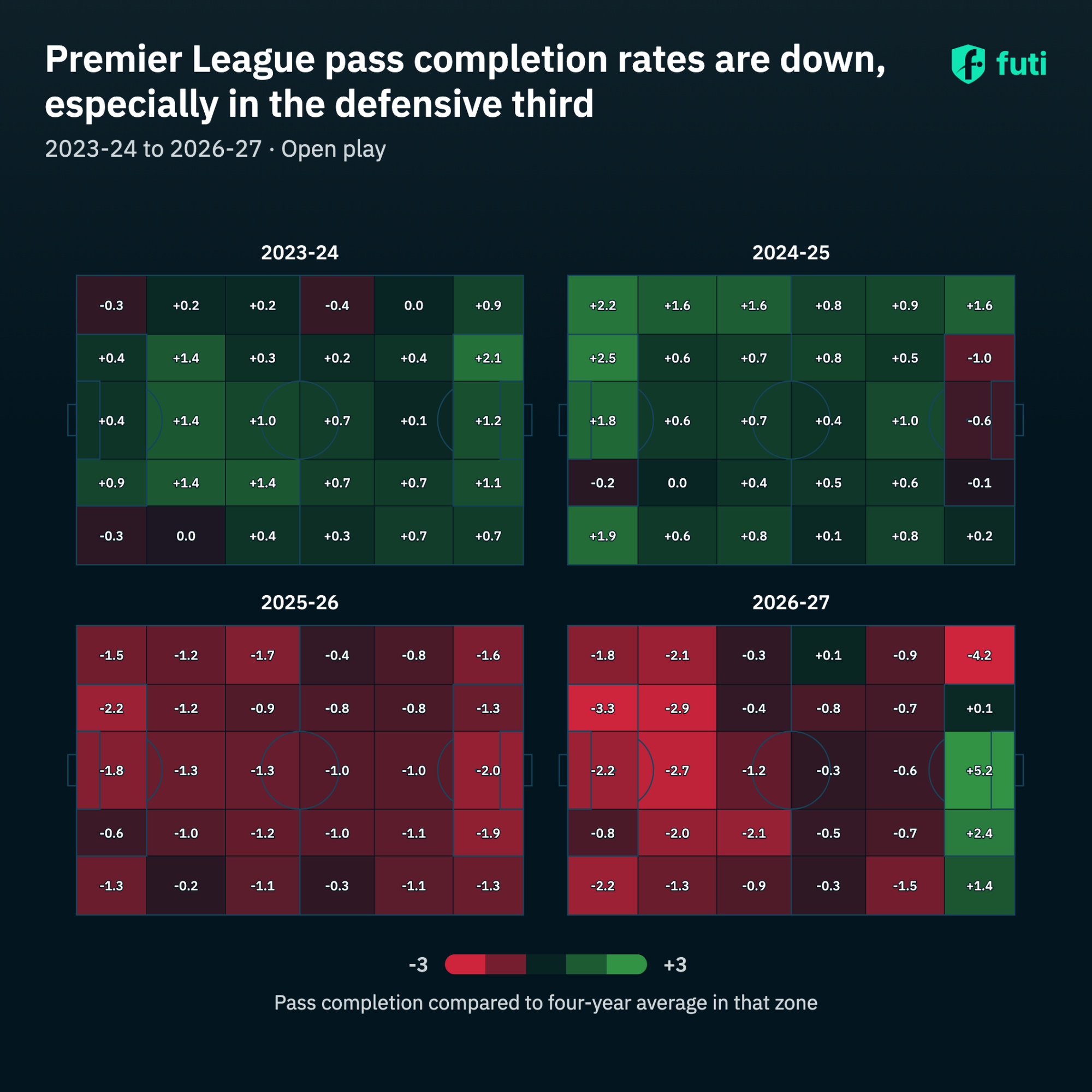
This is the current messy meta in the Premier League: lots of man-marking, lots of direct transitions, not a lot of the beautiful passing patterns that Pep is associated with. By the end of his time in England he sounded like Tommy Lee Jones despairing about the state of the world in No Country for Old Men, telling reporters that teams like Andoni Iraola’s Bournemouth were the future. Don’t let Iraola’s Spanish passport or NYCFC pedigree fool you, he’s no Pep disciple.
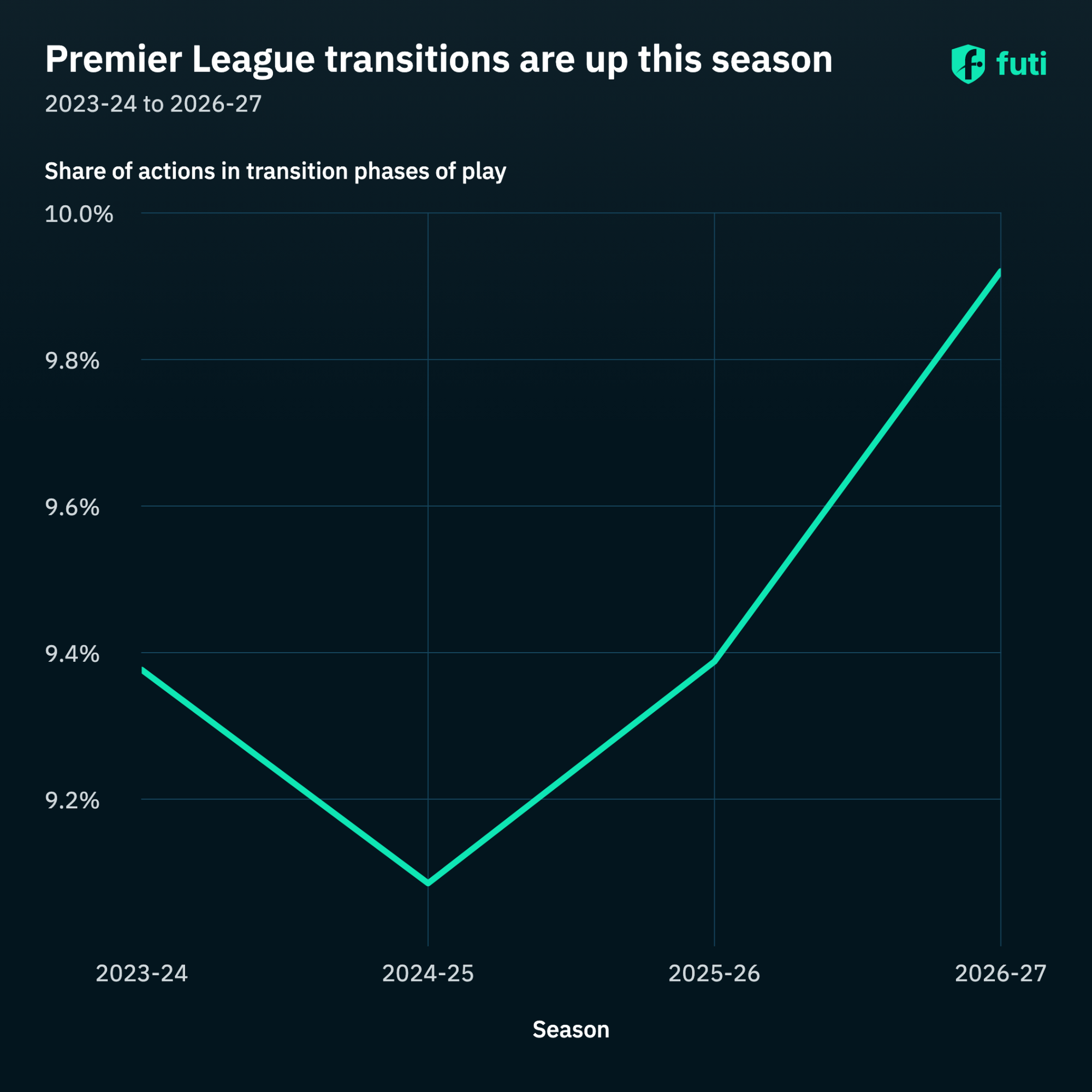
This vibe shift hasn’t hit MLS yet. Interestingly, it hasn’t really even happened in the rest of Europe’s top leagues, at least not as dramatically as England. Maybe that has something to do with Premier League money hoovering up most of the quality players with the kind of physical metrics you need to sprint on and off the ball for 90 minutes, I’m not sure. But soccer follows trends, and I think it’s a pretty reasonable prediction that we’ll see more man-marking and direct transitional play in MLS in the next year or two. It’d be pretty funny if Pep jumped out of the frying pan and into the fire.
MD: Those who are skeptical of Pep tend to think he wins because he has always had the best players, and that his rigidly structured system can only work with the very best players in the world. I think the way I’d put it is that positional play, as a system, only works if every single player on the field is a genius at ball retention. And you’re just not going to get that luxury in MLS.
JM: Guardiola has always been the first to tell anyone who will listen that managers don’t matter.
“I can assure you one thing, it’s impossible to play the way we play, achieve the results we achieved without top players. It’s impossible, and today the top players cost a lot of money,” he said in 2018. “When the people say, ‘You win because you spend €600m’... I don’t know how much money we spent in these two years, but I say they are right. It’s impossible to do that without money. We need money to buy top players to play at that level all the time. To achieve these results, you need this investment. If not, you need a miracle and I am not able to do that.”
But you know what hikers say about how to get away from a grizzly, right? You don’t have to be faster than the bear, you just have to be faster than your buddy. I think there’s some of that here, too. I mean, listen, were peak NYCFC or Wilfried Nancy’s Columbus or whoever as good at positional play or as skilled on the ball as Manchester City? Of course not, but they were better at it than their opponents were at defending it.
It’s absolutely possible to buy a formidable talent advantage over other teams in MLS. Jorge Mas has made that abundantly clear in Miami. For whatever reason, the Emirati powers that be at CFG have never cared enough to, uh, develop a robust sponsorship business in MLS as in the Premier League, but you can bet your ass that would change if Pep Guardiola moved to New York to open a new billion-dollar stadium in the Five Boroughs.
Still, it’s a salary-capped league with complex roster rules, so it’s not easy to spend your way to the top of the table (just ask Atlanta United). You need a clear idea of your game model and squad-building strategy, which obviously having a coach as exacting in his vision and secure in his position as Pep would help with, and then the recruitment team needs to get the signings right. Given the homegrown rules and the talent boom in MLS academies right now, it’s also extremely valuable if you can develop talent, which I think Guardiola’s been much better at than he’s given credit for.
But the really interesting question around Pep to NYCFC is just how far world-class tactics and training can get you. When you get down to it, coaching is mostly about figuring out who your best players are and putting them in positions where they can do what they’re best at. But there’s another part of the job — the part we tend to romanticize because it’s reassuring, somehow, to imagine a game as complex as soccer to be controlled by a single dude who waves his arms on the sidelines rather than emerging somewhat numinously from a million decisions made by 22 independent minds in exhausted, sweaty bodies continuously reacting to one another — that’s about the coach forming a clear idea of how to win soccer games, explaining it in exacting detail, drilling it into players until it becomes second nature to them and then persuading them to go out and actually do it when the whistle blows.
How much difference can a coach really make on that front? Here’s what Pep has had to say:
"It's not what you have to do, it's when you have to do it. That's why football is so difficult. I said many times when we make the [analysis] videos and we pause it and say: 'look guys, the space is there' — this is fake.
“How you have to make the decision, how many times you do it: it only belongs to the players. I've said it many times: we, the managers, are overrated in our influence. The game belongs to them, decisions have to be made and they can express [their game] and do it as many times as they want.”
So yeah, maybe a lot of soccer discourse overstates the influence of managers. There’s a whole cottage industry of academic research to back that up. But seeing the greatest coach of his generation take charge of the 11th best team in the MLS Eastern Conference would give us some interesting new data on this!
MD: What does the data say about creating a talent differential in MLS? The easy answer has always been “DP 9, DP 10, fill in the rest,” but it feels like we’ve moved into an era where the guys who make the game are where smart teams should spend their money. DP 10s still, but also 8s and especially wingers, while 9s can be found elsewhere, for cheaper. Or even developed outright.
Is that how a smart team would look at it? Is that how you think Pep would look at it?
JM: Love this question, so I went down a little bit of a data hole to get you a good answer.
We can start by asking the simple version. If we break players into three compensation buckets — below the maximum budget charge each season, below max TAM, and above max TAM, which for simplicity’s sake I’ll call “Below TAM,” “TAM” and “DP” — how do they rate according to futi’s possession value-based model?
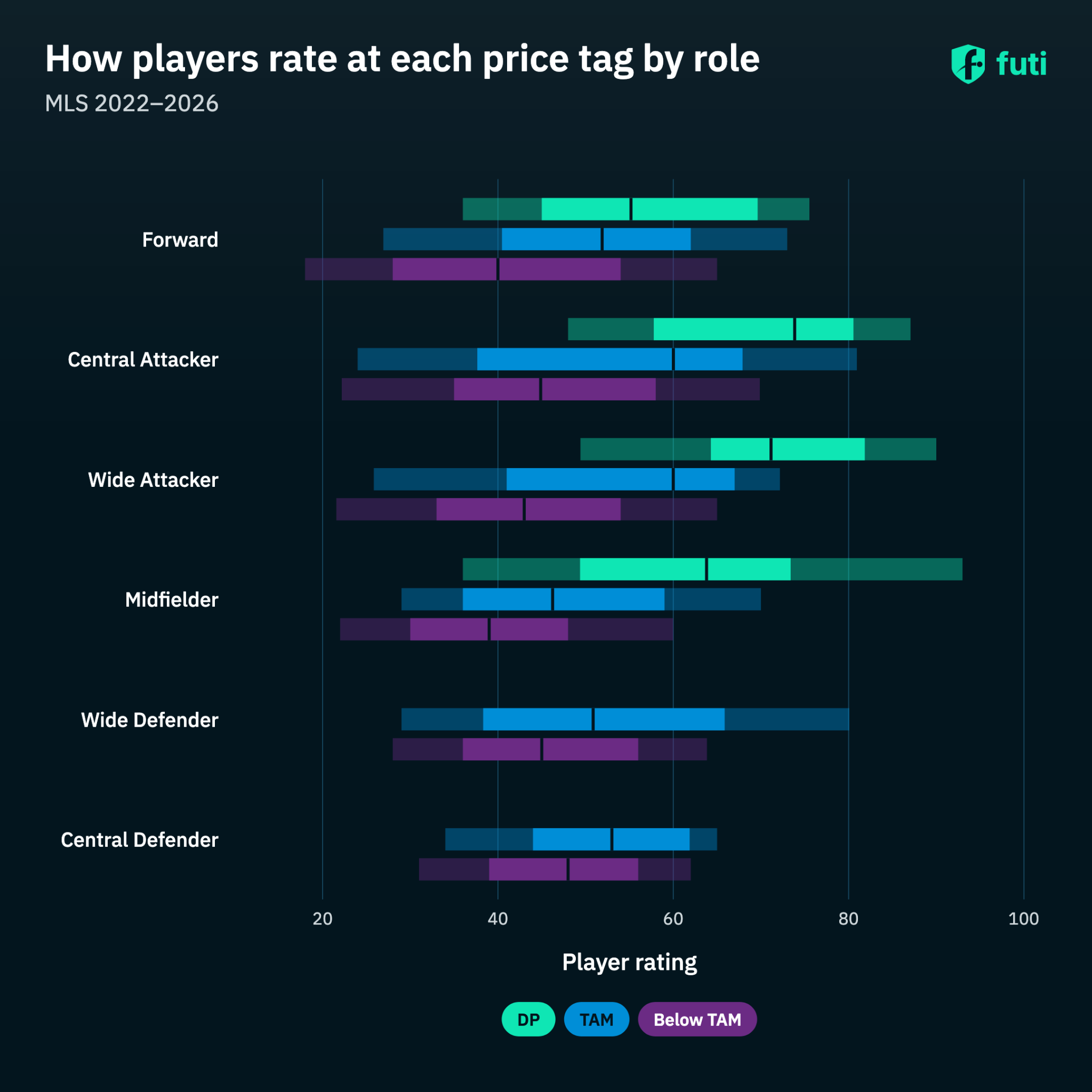
We can see a couple things here. First, MLS spending is directionally correct. In every tactical role, higher spending buckets are correlated with higher player ratings: DPs are better than TAM players, who are better than players earning less than the maximum budget charge. Second, your gut feeling about No. 9s looks like it’s probably right. Over the last five seasons, DP strikers have lower ratings than DPs in other roles; in fact, their futi ratings are barely distinguishable from TAM strikers. That’s less true for wingers and midfielders, where the 25th percentile for DPs (the part of the chart where the bright colors stop) is better than the median TAM player.
But a smart club wouldn’t stop there. They’d want to treat this more like portfolio analysis of player contracts, and they’d only want to sample each player’s first season to avoid survivorship bias. Which is a bunch of mumbo jumbo to say we’re going to find out if new DP signings in each role were any good.
Since we’re only looking at one season per signing, the number of player seasons in each group gets pretty small. Going all the way back to 2015, we’ve only got 15 DP-level earners who futi’s model classifies as midfielders (including NYCFC’s Frank Lampard and Andrea Pirlo) and not enough DP defenders to even be worth breaking out on the chart (sorry, Thiago Martins). Even so, we can pull out some pretty interesting stuff here.
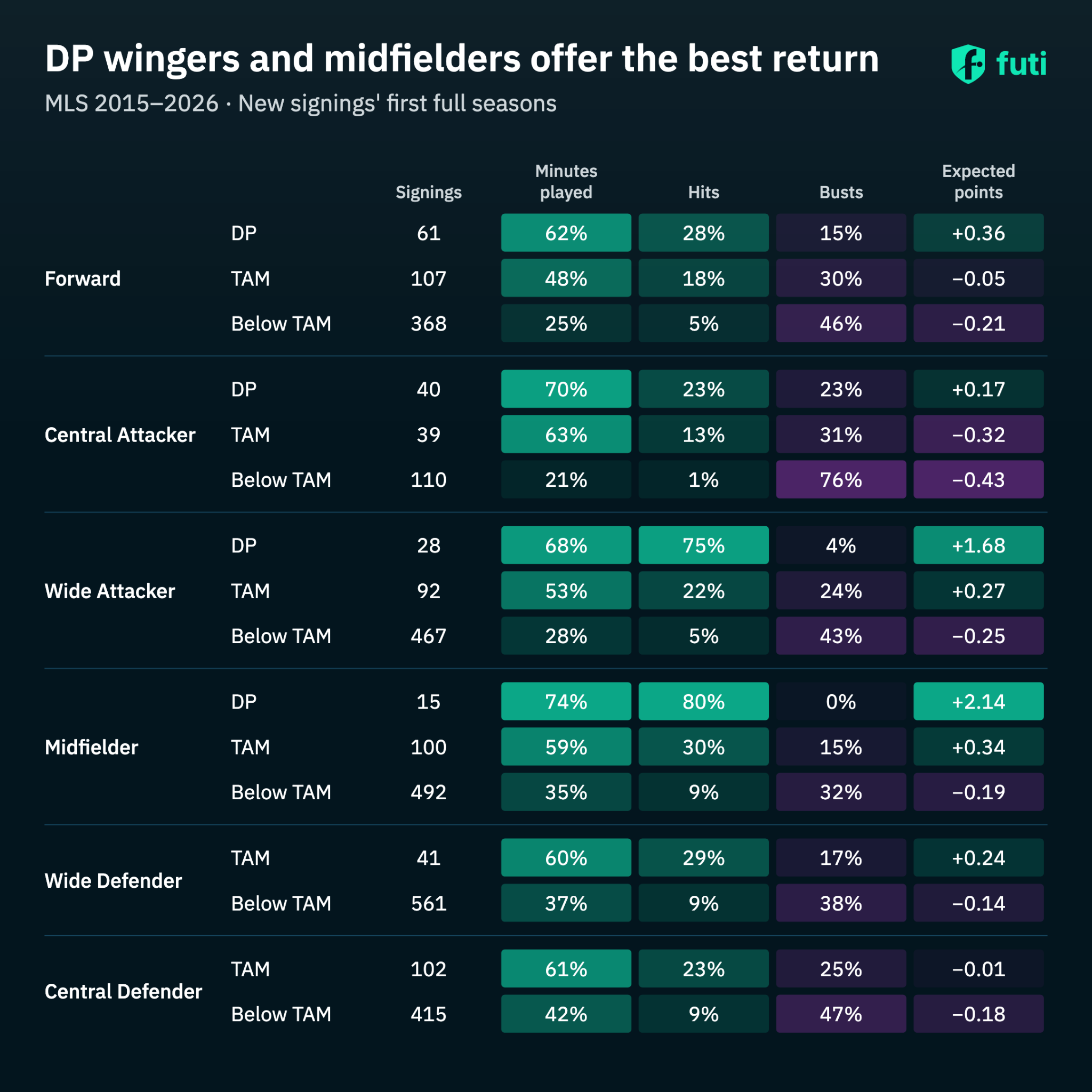
The first question a sporting director should care about is whether new signings got on the field. Whether because of subs or injuries or competition, forwards in both the DP and TAM buckets played fewer minutes than players making similar money in other roles. That’s not a great bit of trivia if you’re shelling out for a DP No. 9.
Next they’d care about upside and downside risk. How often did new signings hit, meaning futi rated them in the top quartile of their role that season, and how often did they bust in the bottom quartile? Here there’s a stark difference between forwards and central attackers in the top income bracket, who hit no more often than chance, and similarly compensated wide attackers and midfielders, who hit over three quarters of the time and almost never bust. When MLS teams spend big for strikers and attacking mids it’s a crapshoot, but on the wings and in midfield they reliably get what they paid for.
We can translate futi ratings to expected points using a method I won’t bore you with except to say that it accounts for playing time, not just performance, and it’s validated against the table so you don’t have to just take the futi player rating model’s word that players are good. The story’s still the same: midfielders and wingers offer by far the best bang for your buck in true DP range, adding about two points per season over an ordinary player in their role compared to less than half a point added by the average DP striker or attacking mid.
It’s also worth bearing in mind that this analysis only looks at salary data, and the picture would get even more lopsided if you accounted for the kind of transfer fees clubs spend to bring in DP forwards. The takeaway? Stop trying to buy last season’s goals and go get some guys who can pass and dribble — they’re a much more reliable investment and you can’t win games without them.
Is this how Pep would look at it? God, I hope not. Please never make Pep Guardiola spend his one wild and precious life reading the MLS roster rules; that’s what sporting directors and directors of player personnel are for. But I think he’d be very happy to have a squad whose most expensive players were in the Xavi, Iniesta and Messi roles.
MD: Do you think it’d work?
JM: Right away? No. NYCFC have too many holes in their squad to plug them all in one window, and like the man said, it’s impossible to achieve the results he wants to achieve without spending money to recruit top players.
In the long term, though? Absolutely. I think he’d bring a clarity of purpose and vision to a club that’s lost some of its identity lately. If that didn’t work, he’d also bring an open line to people controlling many billions of dollars’ worth of sovereign wealth, which tends to do the trick.
In all seriousness, even as a "managers don’t matter" guy, I’d be pretty stoked to see what Pep could do with an MLS team. I want to watch him rewire players’ brains and open their eyes to a new way of thinking about soccer. Let him inspire a generation of American coaches and change the kind of players our academies produce like he did in Germany and England. Above all, let’s beam his face onto every TV on the planet and get people talking about MLS. Anyone who was curious about Bill Belichick coaching in college would immediately get this story. Tourists might even learn how to catch a 7 train from Times Square to Willets Point. Whether or not he won anything with NYCFC, I think Guardiola would give the MLS marketing department a mulligan on the failure to turn Messi and a domestic World Cup into cultural cachet.
MD: Finally, let’s say he takes the job. And five years from now he’s won a couple of trophies, and developed a couple of really good young players, but hasn’t built a dynasty or reinvented the league or anything like that. Forget Pep’s legacy… What would that mean for MLS? Would it be a good thing or a bad thing? Is it “the league that even Pep couldn’t solve!” or is it “the league that still doesn’t give its teams resources to be truly great?”
I have to admit, I’m kind of on the fence about this one.
JM: I’d like to imagine the world would come away saying things I believe are true, such as that MLS already has much better coaching talent than it’s given credit for or that roster rules imposing some degree of parity makes soccer more interesting and fun.
Let’s be real, though — if Pep didn’t win, and win in interesting ways, most people outside the league wouldn’t talk about it at all. How often did you check in on the Turkish SuperLig when Jose Mourinho’s Fenerbahce were a distant second to Galatasaray? Pep would either lead a revolution and change the course of MLS history or else five years from now everyone would forget he was ever here.

Referrals from people you trust are the name of the game in digital media these days – it's the way new people discover new things. So if you want to help me out a bunch you should forward this along to someone who's MLS or USMNT-curious and trusts your judgement.
Or if you want to be even more helpful, you could drop $5 and give them a gift subscription for a month!
Comments ()