Rating the US U-20 prospects through 4 games
The US are into the quarters of the U-20 World Cup... again
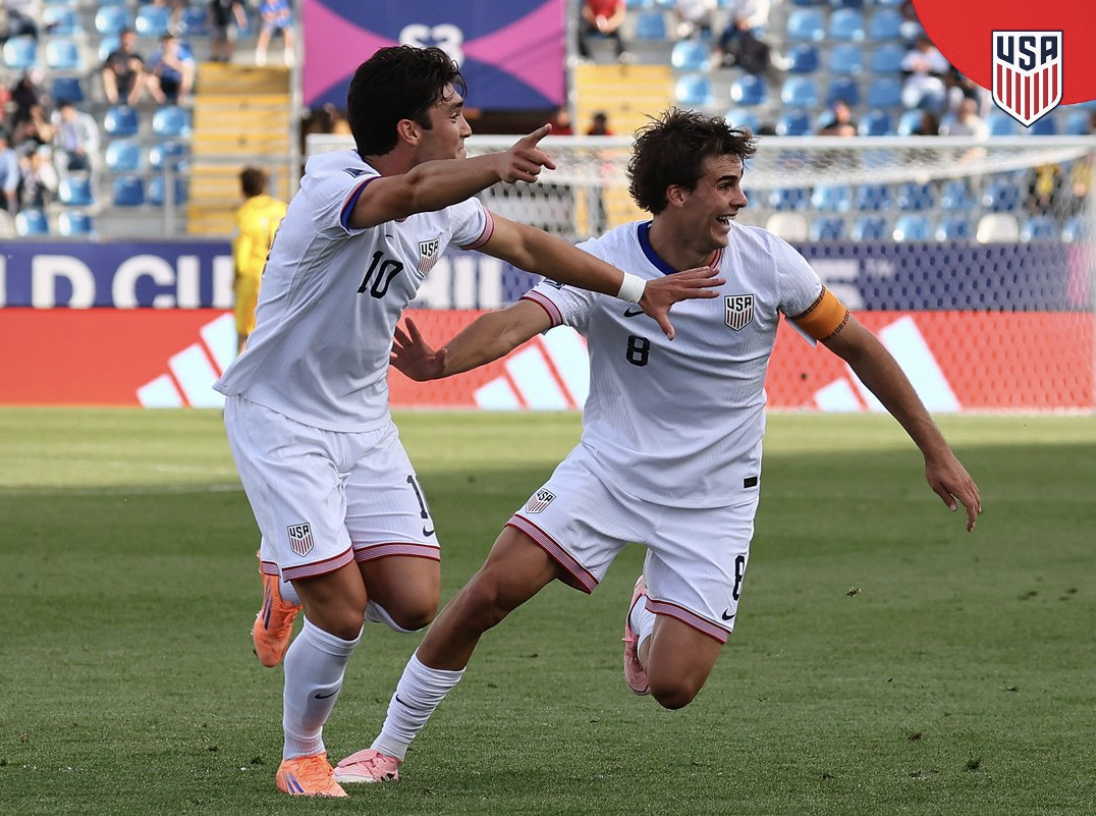
The US U-20s beat Italy 3-0 on Thursday, and are now into the U-20 World Cup quarterfinals for the fifth consecutive tournament. It’s the first time anyone’s gone to five straight – literally anyone – quarters since Brazil did 13 (lmao) straight from 1981 to 2005 (thanks to Jordan from Scuffed for that one).
This is all directly downstream of the 2007 MLS academy initiative, and you can see it if you simply look at the US squads from each of the past five tournaments. The 2015 group was the first US U-20 team that was more than half developed in MLS academies, and the percentage of MLS academy-developed talent has increased with the 2017, 2019 (the best of the bunch IMO), 2023 and, now, 2025 groups.
- This run comes on the heels of a fallow period from 2009 through 2013, where we got grouped twice and missed the tournament once entirely. Those rosters were largely filled with college kids.
- That came after a strong three-cycle run from 2003-2007, culminating with that incredible Bradley/Jozy/Adu-led 2007 team that was, in my opinion, the second-best team at that tournament.
So what makes this era different than that one? First, the mid-2000s teams all had one thing in common: Freddy Adu. He was on each of those squads, and while it’s hard to remember this now because he’s become such a cautionary tale, he was an utterly dominant youth player, the type of No. 10 who’d elevate everyone around him.1 Those players have outsized effects at youth levels.
Second, this run is spread over 10 years and five distinct cohorts. There’s no one centerpiece who’s been key to more than two of these teams.2 It’s just structural now, and once a structure that constantly churns out this type of pro gets put in place, the floor just constantly gets higher as success begets more success.
As the floor gets higher, the demands on youth players breaking in become more rigorous, which produces better youth players, which pushes the floor higher, and suddenly you’ve developed institutional knowhow that is both broad and deep and that’s when, baby, you got a stew going!
This is the kind of developmental environment necessary to create a program that could someday produce a World Cup winner,3 or at the very least a team that can have realistic hopes of breaking into that group of ~9ish countries atop the game. Those are the teams that have realistic hopes of lifting that trophy. The US is not there yet.
But the journey is well underway. Even the most hardened of skeptics can’t handwave five consecutive quarterfinals appearances.
Ok, with that in mind I thought I’d give you my assessment of the current US roster using college recruiting (basketball or football) standards, 1-through-5 stars.4
- Five Stars: Potentially world-elite player whose career can only be derailed by injury or off-field issues (Gio Reyna would be an example of all of the above).
- Four Stars: Clearly going to be a high-level pro and likely a meaningful part of future full USMNT groups.
- Three Stars: Good pro prospect who could end up making a USMNT mark if he ends up in the right situation and a bit of growth (be it physical, tactical or technical)
- Two Stars: Probably a good pro.
- One Star: Just happy to be here!
Four Stars
- Josh Wynder, Frankie Westfield
Let’s take Westfield first: he’s a guy who I’ve seen a ton of because he’s played a ton of minutes this year in MLS with the Union. That alone is a good sign – “can you be a starter in the top flight for a team with legitimate title aspirations?” is a hurdle lots of U-20 national team-caliber kids never take.
Westfield had already cleared that one before he played a second at this tournament. The question he had to answer was whether his success was born of his fit within Philly’s, ah, let’s call it “attritional” game model, or whether he’s the type of well-rounded soccer player who can add value within a more controlled blueprint.
And it turns out he’s cleared that bar just as easily. I thought he was the Man of the Match against France, where his ability to come inside and become a progressive passing platform rather than simply an endline-to-endline overlapping threat really tilted the final 25 minutes of that game.
Wynder hasn’t been perfect, and I doubt he’s about to break into regular minutes with Benfica’s first team. But he checks all the boxes you’d want to see physically with his size, quickness and aerial strength, while he’s shown a level of calm on the ball – both when being pressed and picking his passes – that’s a-typical for young center backs.
The thing that’s really caught my eye, though, is his front-foot defending. He doesn’t always get it right, but he’s clearly got the type of soccer IQ that leads to him reading the game rather than just reacting to it.
I can’t wait to see what this kid looks like with 5000 first-team minutes under his belt. I don’t blame him for going to Benfica – it’s Benfica, for god’s sake, one of the very best talent development sides in the world – but in a different universe he ends up with the Fire throughout this past season, plays 2500 minutes, and is in the full USMNT camp next month with a clear path to the 2026 roster.
He’s that kind of talent. Let’s hope he goes out on loan to a place he can play first-tea minutes this January.
Three Stars+
- Brooklyn Raines, Taha Habroune, Benja Cremaschi
These are guys who all have played well and have obvious skills that make them intriguing, but obvious deficiencies that make them something less than a sure thing.
With Raines he checks every box – including top-flight playing time – that you want to see from a d-mid save for progressive passing. He reads the game well, he wins the ball, he does not back down physically, and he’s smart about taking space going forward when opportunities present. He does not ever compromise his team’s shape.
He just needs to be better breaking lines and building attacking rhythm from deep in the midfield structure. If he adds that he becomes a four-star guy.
Will Taha grow into his body and become some level of physical presence both on and against the ball? If yes, he’s a four-star because of his comfort on the ball in traffic and the way he is able to combine, at pace, in tight quarters. He is always disorganizing the opponents and putting his teammates into high-leverage spots.
If he doesn’t become a physical presence, he’s still going to be a very good MLS player.
Cremaschi has been the big star of the tournament so far, and has stood out as a fast processor of the game with an endless engine and plus physicality. In order to play central midfield at the highest levels, though, he needs to clean up his first touch in traffic.
Three Stars
- Niko Tsakiris, Luca Bombino, Peyton Miller, Zavier Gozo, Cole Campbell
I love Tsakiris, and my hope is that other MLS teams look at what the Dynamo did with Jack McGlynn this season and say “hey, we can do that with Niko!”
Like McGlynn he’s best used as a No. 10. Like McGlynn I think he can play his way into the USMNT picture, and like McGlynn I think his ceiling is ultimately limited by athleticism/defensive concerns, which may be insurmountable.
Is Bombino the left back version of that archetype? I will say that while Westfield has answered questions re: whether his MLS excellence is a product of his team’s distinct game model, Bombino has actually opened those questions up with his performance in this tournament.
I’m not selling any of my stock; guys who can move the ball and conduct the game like he does are too valuable to look past. But I’ve got some concerns.
I’m giving Miller – the youngest player on the roster – a bit of a mulligan given he’s played as a winger throughout this tournament while having been a wingback or fullback all season for the Revs. With New England his job was purely linear, and he did it well. At this tournament he’s struggled coming inside and has often been a step or two behind the play.
Gozo’s constantly been able to beat his man and get into space, whether he’s played on the left or the right, and has constantly failed to provide the final ball. He looks, to me, like an incredibly toolsy kid on a pretty normal developmental pathway.
I think everyone is frustrated by Campbell at this point. He’s one-footed; he is prone to dribble-blindness; he stops play to do useless stepovers when he should’ve immediately attacked a scrambled defense. The lower levels of the game are littered with wingers like that who never put it together.
The top levels of the game are filled – the very biggest clubs in the world, mind you – with guys who do put it together. There is a reason Dortmund still have Campbell rostered: If he figures it out he could become the best player from this cohort.
If he doesn’t, he’ll be this group’s Gedion Zelalem.
Two Stars
- The entire rest of the roster.
Notes on the rest of the group:
I might be too low on Reed Baker-Whiting at this point, but I’m worried that he hasn’t won a starting job with the Sounders, and now hasn’t won a starting job with the U-20s, and I still don’t know what his best position is. He’s already a pretty good pro, but his path towards “high-level difference-maker” has definitely stalled out over the past two years.
Nolan Norris has really caught my eye. Just super smart about reading the game, but he might be a ‘tweener. Dallas going to a back three could end up being very good for his future.
Neither Ethan Kohler nor Noah Cobb look like high-level prospects at this point, which is fine. Tim Ream wasn’t a high-level prospect when he was 20, either.
I like the combativeness I’ve seen from Marcos Zambrano, and he has good instincts in combination play. Less-good are his goalscoring instincts, but those get sharpened with reps,5 and he’s scored for fun so far in Next Pro. Check back in a year when he’s logged 2000 minutes (and hopefully 20 goals) there.
Pedro Soma and Matthew Corcoran have both looked a little heavy-footed to me, but I’m not going to bet against either becoming very good pros at the least. And bear in mind that Kyle Beckerman was also pretty heavy-footed.
I’m glad Adam Beaudry is getting pro minutes, spread across both Next Pro and the USL-Championship. I don’t think anyone’s counting on him breaking into the mix for the next World Cup cycle, but I don’t think he’s done anything to suggest he shouldn’t be an Olympic consideration.
EDIT: I am sorry, Luke Brennan, I forgot you in the first go-round! From what I’ve seen both with the U20s and Atlanta, he’s got really good playmaking instincts but lacks top-end athletic pop, and hasn’t really produced a ton of end product even at the Next Pro level.
Certainly he should get more MLS minutes next year with Atlanta’s first team – I’d be disappointed if he didn’t crest 1500 across all comps. But he’s got to become goal dangerous to make that stick.
Provided they’d do the defensive running for him, which that era of US players happily did. And we just also happened to luck into – yes, it was luck; there was no truly intentional development happening then – other inventive midfielders like Sacha Kljestan, Benny Feilhaber and Lee Nguyen during that time. There was always a force magnifier to run the attack. ↩
The only guy who was key to two teams was Cameron Carter-Vickers, who was a starting CB in 2015 and 2017. Erik Palmer-Brown was also on both those teams though was only a key player in 2017, while Niko Tsakiris was a reserve for the 2023 group before becoming a starter with the current squad. ↩
To be clear, you also need luck. You can’t plan to develop a Messi or a Mbappe or a Müller or a Xavi, and you can’t win a World Cup without a player or five at or near that level.
What you can do is put in place a developmental structure designed to cultivate and maximize a world class talent like that should you luck into one. ↩
Spoiler alert: There are no five-star talents on this roster. Though there is a chance that 18-year-old center back Noahkai Banks, who was not released by his club side Augsburg, is a five-star talent.
I haven’t seen enough of him to say definitively, but my early take is that he’s just shy of that rating. Compare him to fellow teenaged Bundesliga CB Finn Jeltsch, or the even younger Barcelona prodigy Pau Cubarsi.
Levels. ↩
It’s so important for young strikers to be on the field in a functional system so they can understand 1) where goals come from, and 2) how to set up defenders off-ball in order to get to where goals come from. ↩