
Save the 'Caps
Move a club – even threaten it – and you reveal the whole endeavor is nothing but a billionaire’s plaything

You've seen the reporting, I'm sure. "MLS owners talk potential Vancouver relocation, with Las Vegas a top option: Sources" from Tom & Paul at the Athletic. "Whitecaps to Las Vegas? Maybe, but probably not" from Patrick Johnston, the main sports columnist at the Province. "Source: MLS exploring Vancouver Whitecaps relocation" from the great Jeff Carlisle at ESPN.
It has been simmering for a while, and even reported out a bit over the past year before the dam really burst this past week: the Vancouver Whitecaps, one of the most storied clubs in North America and arguably the best in MLS right now, are up for sale. They have been for a while. And there have reportedly been no takers.
And so, because this is North America, that means there is, reportedly, an imminent and very real threat of relocation. Just like that, club history goes up in a puff of smoke.
That's how it works here. We all know this, and many of us have lived through it. My dad was a Brooklyn Dodgers fan; he raised me, a Hartford Whalers fan. He died bitter. I will, too.
I also live a generally optimistic existence, and I am optimistic that what worked last decade in Ohio can work this decade in British Columbia. People are fired up. And hell, maybe it can even go (inter)national! Call your representatives and MPs!
But I also just want to talk a little bit, as someone who's spent his entire adult life trying to grow MLS (in quality, in value, in popularity, but most importantly: in cultural relevance), about how this just makes it... hard. This makes it really, really hard for MLS teams to be culturally relevant in a way that drives fandom, and popularity, and quality, and, ultimately, value.
Because the way these franchises become culturally relevant is by becoming more than a franchise. They become clubs that are passed from parent to child, from one part of a community to another, and are built and maintained in a way in which they just naturally take in the tired, the poor, the huddled masses yearning to live and breathe soccer. Not just over there, but here, too, with what has now become their club.
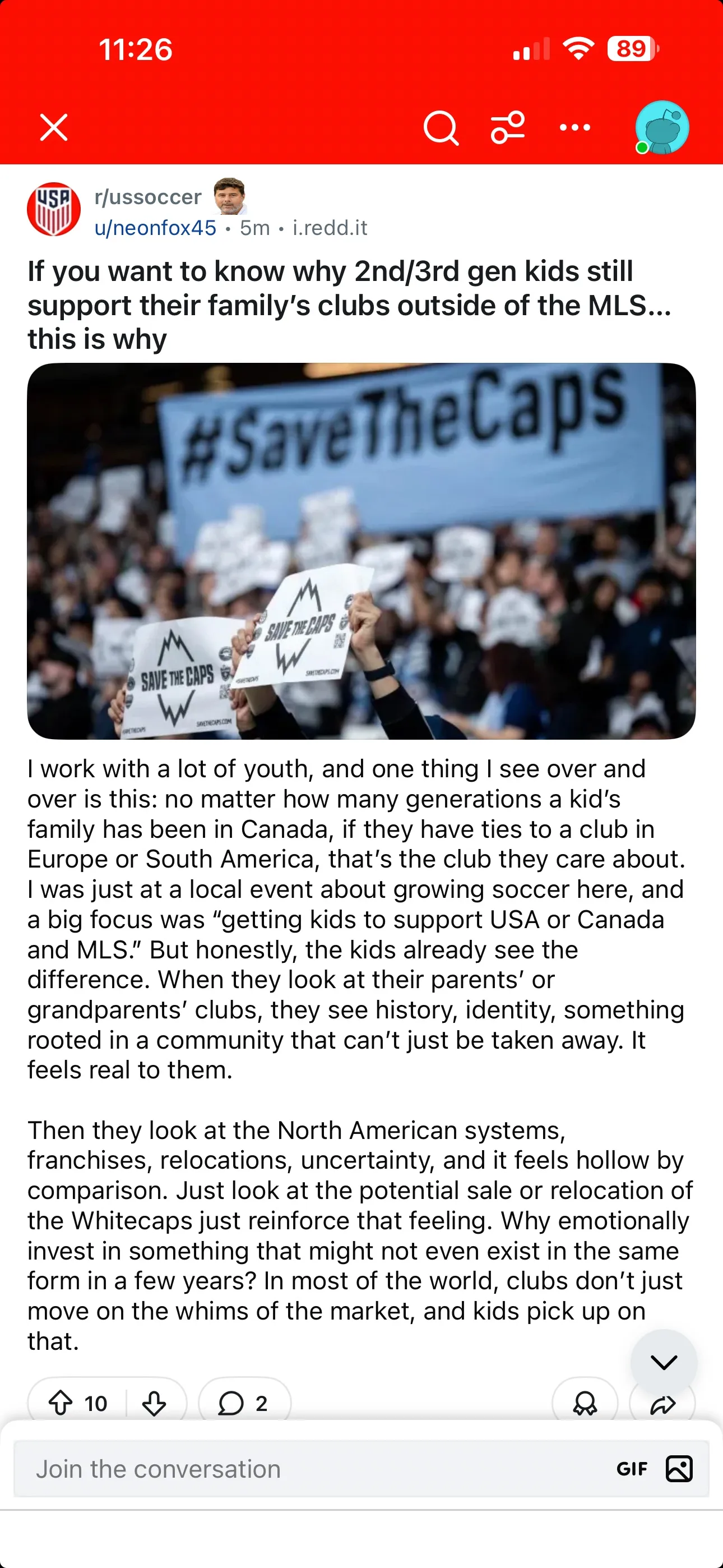
I don't know if the tale in the above post is real; I always take those sorts of anonymous online anecdotes with a grain of salt. But this one, in my experience, rings largely true. So even if the story itself is fake, the sentiment sure seems real enough:
Move a club – even threaten it – and you reveal the whole endeavor is nothing but a billionaire’s plaything(s). That paragraph above, about the huddled masses yearning to live and breathe soccer, and make the local club their thing? That's not just immigrants new to town; it's baseball dads learning a new sport because of their kids, or it's MLS-curious dudebros who play Argentina on FIFA because of Messi, or it's the local 12-year-old who's juuuust on the precipice of caring more about his local rather than choosing a lifetime of Eurosnobbery.
You don't get those fans if everyone knows you can just Baltimore Colts it in the middle of the night. How can you unconditionally love someone who's perpetually threatening to leave you? Fans elsewhere don't have to answer that question.
The threat of relocation, of the abnegation of a club's history just like that because there's a better real estate deal to be had three states over means the scale of passion we see in the stands in Dortmund – or, if you want to keep it closer to home, next week at El Volcan – will always be two generations away. Those dudebros will always choose France vs. Argentina, and those kids will always choose Real Madrid, and MLS will always fall just short.
You understand what that means, right?
We will never get there.
Now to be fair, fans of the NFL, NBA, MLB & NHL go through this same thing. But those leagues are all at the very pinnacle of their respective sports, so they have a kind of credibility MLS has not approached (weirdly, the NWSL has been reluctant to open the checkbook and unambiguously claim this title for women's soccer; instead of leaving every other league in the dust, they have allowed Europe's best to close – or, even eliminate, you could argue given recent results – the gap). That credibility means cultural relevance, which is why the A's can do what they've done and fallout has been minimal.
I will note that many of the biggest soccer clubs in the world have become, yes, billionaire's playthings as well. That includes teams that, if you'd told me 40 years ago they were among the biggest in the world, I'd have said "yup" (Liverpool) and teams that, if you'd told me 40 years ago they were among the biggest in the world, I'd have laughed in your face (Chelsea). Either way, there’s less wiggle room between Liverpool and Vancouver than Liverpool fans would like to admit. Your happiness as a fan depends largely upon some billionaire's willingness to spend bigly and wisely.
That said, when we’re talking about the great clubs of Europe or Latin America, we’re at least talking about clubs that have spent generations earning their local bona fides. Many in MLS haven't had time for that step; many others have never even seemed to know it exists.
Ironically, that doesn't include the 'Caps, who've meant so much to so many for so long. Even so, that wiggle room between them and Liverpool manifests functionally as a chasm: for one, it's conceivable they could "move" and just... be the same team, but somewhere else. For the other, never in a million years could that happen.
I don't think it's wrong for soccer fans here to choose to support the second option. And that will never stop being a problem for MLS until MLS stops making it a problem.
Ok, like I said above, I am actually an optimist. And so I want to end this on an optimistic note:
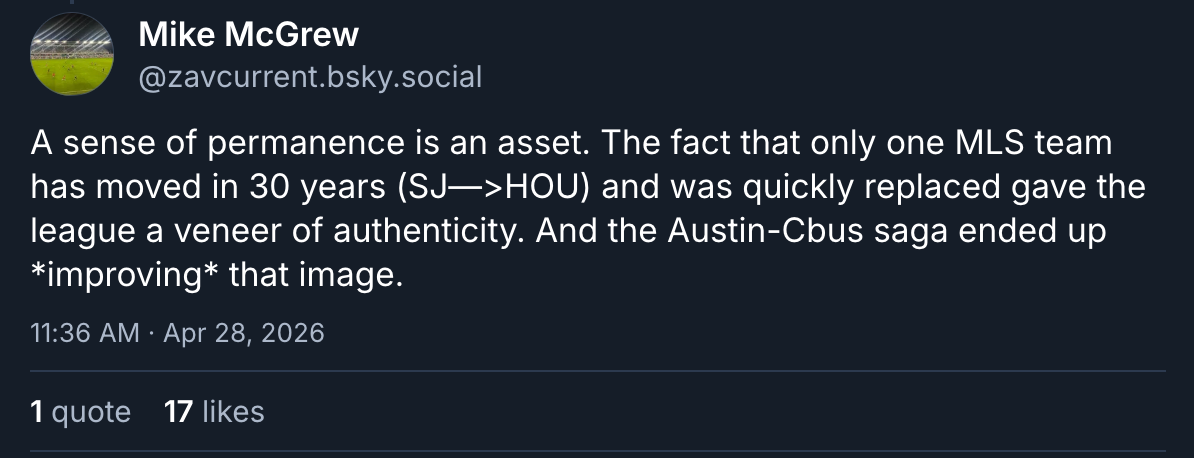
This is a really well-taken point from Mike. MLS has outlived the NASL and outstripped all expectations over the past 31 years, and is permanent in a way that no other soccer league in the history of the US or Canada has managed. It is also culturally relevant in individual markets – including Vancouver – and not because of Messi, nor because of Beckham before him.
It's because the fans have worked, in some cases for generations now, to turn these into clubs. Look close enough and you'll see the hardest yards have already been run. There is growth, there is momentum, and there is cultural relevance that can be both broader and deeper than what anyone had a right to expect a generation ago.
So let's let the marble remain the marble; the granite remain the granite; the oak remain the oak; and the 'Caps stay in Vancouver.

Comments ()