Signs of life for Chicago, the East is sorted & the West goes to Thunderdome | Matchday 34
Wild times down at the red line in the West will be the main course on Decision Day
Note that this is my last Sunday night recap column of the year. Next weekend instead of a recap I'll be publishing my Playoff Tiers, as is tradition on Decision Day.
That will be followed by off-season offseason guides for the dozen teams that didn't make the postseason, as well as USMNT coverage during the international date. Beyond that I still haven't quite figured out what my cadence and output will be during the playoffs, but obviously I will be covering all of it.
Thanks for sticking around this year. While things haven't gone perfectly – I owe the Max TAM and DP subscribers a few Brown Liquor Specials and some Q&As! – it's been a hell of a lot of fun, and I literally could not do this without you.
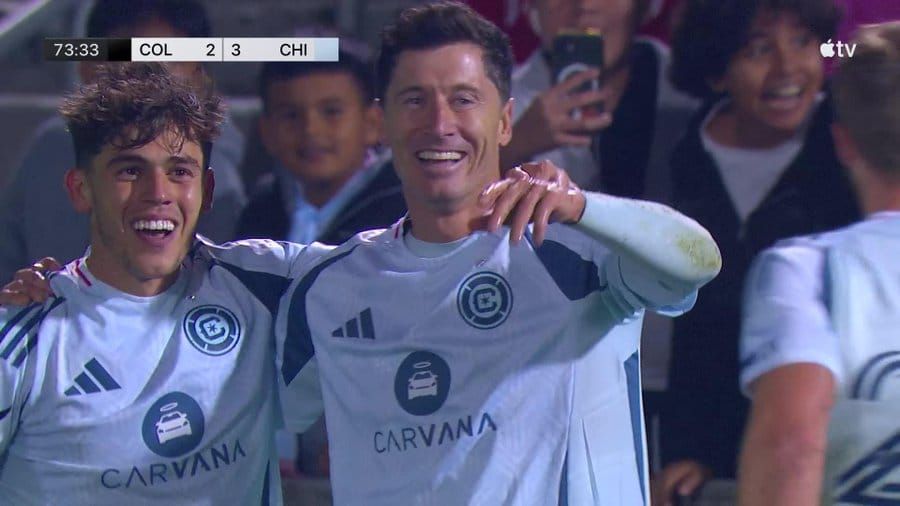
I'd been waiting most of the past five months for the Chicago Fire to show some life. Over the final 30 minutes in Colorado on Saturday night – a 4-2 win in which Robert Lewandowski finally broke his scoreless drought, and in which the Fire finally looked like a team working together to create real danger – they finally did, and I think there were two pretty distinct reasons for it.
The first was Colorado's decision to go with a man-marking scheme. That's an aggressive way to defend, but it comes with a pretty significant trade-off: you're asking your players to follow their assignments all over the field, which means you're also asking the opposition to move. A lot. You can't just stand in your spot, wait for the ball and expect to play through a man-marking scheme*. You've got to make defenders make decisions, drag them into uncomfortable spaces and create separation.
(*) You can't really do this and play through any scheme, but especially man-marking, which has come back into vogue over the past few years as a counter to pure positional play.
The simplest way to do that is with a check-and-go: check toward the ball, get your marker moving in that direction, then spin off his shoulder and attack the space you've just vacated. Do it consistently, and you start creating little domino effects. One defender follows, another has to cover, a midfielder gets pulled out of position, and suddenly there's a gap somewhere else on the field.
That's the kind of movement that's been missing from the Fire a lot in the second half of the season, as far too often they've looked like a team waiting for somebody else to make something happen instead of a team working together to make a specific thing happen. Against Colorado, they were moving with coordination, making runs without the ball and forcing the Rapids to defend in uncomfortable situations. The man-marking scheme gave them a problem to solve, and also a pretty clear blueprint for how to solve it:
- Move.
- Move again.
- Keep moving, dummies.
It forced them to be dynamic in a way they haven't been. And lo, it was good.
The second reason was Gregg Berhalter's decision to hold Lewandowski until the 63rd minute. Colorado were always going to have a difficult time maintaining their intensity for 90 minutes, particularly with all the ground their scheme required them to cover. By the second half, those legs were going to get heavy, the distances between defenders were going to grow, and the spaces between the lines were going to become more inviting.
That's exactly when you want a fresh Lewandowski on the field. He's one of the best players in the history of the game at recognizing those little pockets of space before they fully open up, finding them, and turning them into goals and assists (mostly goals, tbf). Which, as it happens, is exactly what he did.
A goal and an assist. Funny how that works.